Consolidate your company’s expertise through innovative terminology extraction using AI-supported processes.

Consolidate your company’s expertise through innovative terminology extraction using AI-supported processes.
Terminology management for your translation processes
Specialist terms must be translated consistently in all foreign languages. Usually, translators can only translate company-specific terms in cooperation with the customer. Active terminology management for products, specialist terms, and innovations is an important component of the translation process.
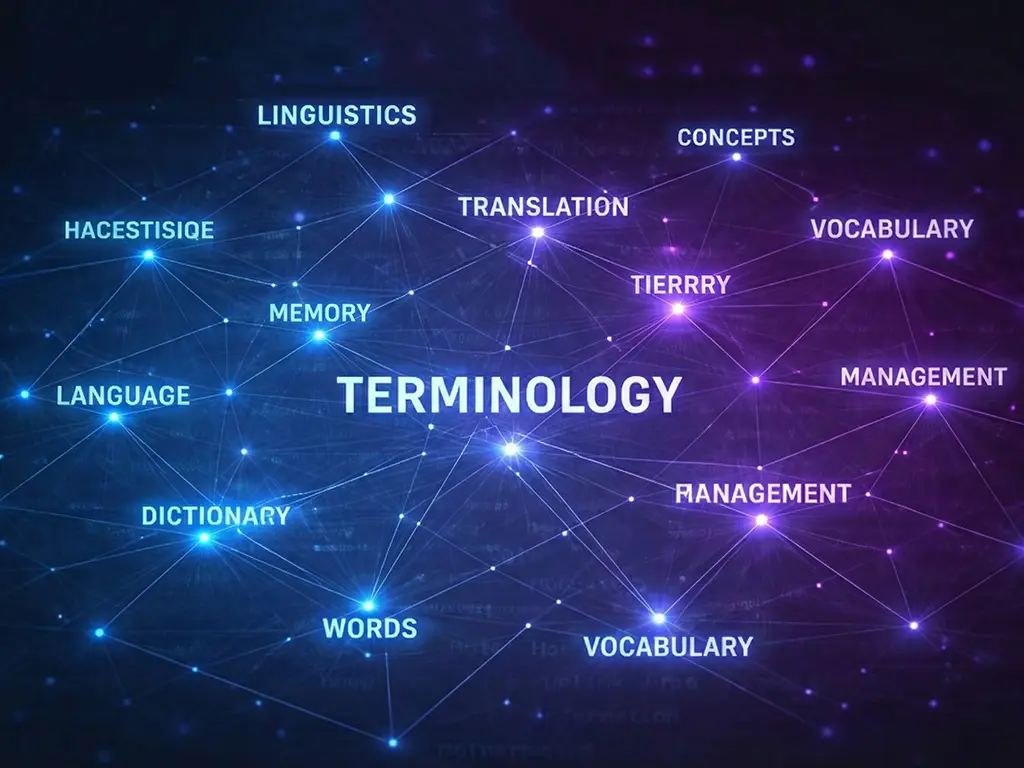
Consistent terminology as the basis for your translation quality
With the help of powerful translation memory systems and individually structured terminology databases, KERN integrates your terminology management directly into the translation process.
This allows you to benefit from greater efficiency, consistent terminology, and improved quality assurance across all languages and content.
Would you like to make your corporate language consistent and efficient?
We support you in building, maintaining, and integrating your terminology—for clear communication, better translations, and sustainable quality. Get some non-bindingadvice.
Terminology management – definition and meaning
Terminology management is a key process in the language industry that involves the systematic management of specialized terminology in companies and projects. It includes creating, maintaining, and organizing terminology databases to ensure that terms are used consistently and uniformly in all communication materials.

Consistent terminology in translation
The goal of terminology management is clear and consistent internal and external communication. A reliable terminology database enables employees, translators, and editors to access standardized terms and definitions. This reduces misunderstandings and ensures that content is conveyed clearly in all languages.
Terminology management plays a crucial role in the translation process: Access to defined terminology databases helps translators use technical terms correctly and increases the quality, accuracy, and efficiency of translations. Consistent terminology is essential, particularly in specialized fields such as technology, medicine, and law, to ensure that the communication is understandable and technically accurate in every target market.
How does KERN help you create a terminology database?
KERN will create databases, glossaries, equivalence tables, and terminology lists in collaboration with you to help consolidate your company's expertise. A company-specific dictionary or glossary is an indispensable and versatile tool that standardizes the company's use of language – from research to sales; it improves the consistency of documentation and translations, is a valuable aid for external translators, and speeds up onboarding for new employees.
Using software tools, KERNs analyzes existing customer documentation, extracts specialist terms, and creates equivalence tables.
When creating company-specific dictionaries, KERN's terminologists consider the needs of individual users and departments as well as the requirements of company-specific software. The tables are added to and updated in the course of future translations. The tables are maintained in multiple languages with the help of data management programs.
What does the KERN database service include?
KERN’s database services include:
- Terminology extraction with software support
- Building customer-specific terminology databases
- Correcting and maintaining existing terminology databases
Your company can arrange to use KERN's existing resources for creating terminologically consistent source texts at any time instead of building separate term bases, which improves the speed, quality, and consistency of translations.
Our technologies
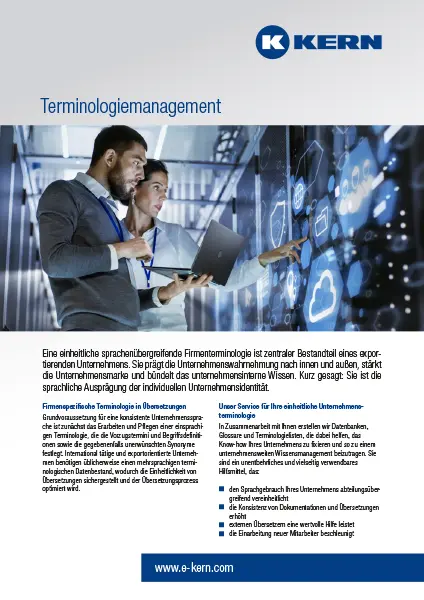
Information sheet Terminology management
All benefits, areas of application, and services summarized concisely—clearly presented in the information sheet.
Terminology extraction – definition and scope of application
Terminology extraction is a central component of terminology management and language technology. It describes the automatic process for identifying and extracting technical terms from large amounts of text or document collections. The goal is to identify relevant terminology, classify it, and transfer it to terminology databases.
Modern terminology extraction tools use statistical methods, machine learning, and natural language processing (NLP) to analyze complex texts and identify domain-specific technical terms. This is particularly important for industries such as technology, medicine, and law.

Terminology extraction as a basis for terminology management and translation
The extracted technical terms form the basis for creating and maintaining terminology databases, which are used in further terminology management and in the translation process. Accurate terminology extraction improves the consistency and quality of communication, optimizes translation processes, and increases the technical accuracy of specialized content.
Advantages of LLMs in terminology extraction
The use of large language models (LLMs) enables context-based analysis of texts and the recognition of semantic relationships. This allows technical terms and their translations to be identified and evaluated more precisely than with traditional rule-based approaches.
Terminology extraction at KERN
KERN helps companies with terminology extraction and securing internal company know-how. Using modern extraction tools, company-specific terminology is identified, checked by native-speaking translators or terminologists, and coordinated with your personal project manager. Terminology extraction can be carried out during a project or as a preparatory step for translation projects, and contributes significantly to internal language consistency.
How can the terminology extraction process be described?
The terminology extraction and validation process comprises several steps, which are carried out both automatically and manually. This ensures that the extracted terms are precise and application-oriented:
1. Bilingual term extraction:
- Input of a bilingual file (XLIFF, TMX, XLSX, CSV).
- Analysis of texts in the source and target language using an LLM that understands the context and recognizes relevant terms.
- Application of the extraction parameters (see below).
- Output of a structured table or termbase.
2. Manual validation by a terminologist:
- Review of term candidates.
- Supplementation or adaptation of the terms to make them more precise or specific.
- Categorization and tagging in preparation for later integration of the termbase into other systems and applications.
- Creation of definitions and context examples.
3. Customization of the termbase for specific application purposes, such as:
- Corporate wording for a CMS.
- Glossaries for machine translation engines.
- Terminology database for a translation management system (TMS) or editing system.
- Keywords for Search Engine Optimization (SEO).
What parameters are used for term extraction?
Extraction is based on the following parameters:
- Source Language: The language from which the terms are to be extracted.
- Target Language: The language into which the terms are translated.
- Maximum Term Length: The maximum length of the terms, i.e. how many words a term may contain (e.g. a term with a maximum of 3 words).
- Similarity: This indicates the similarity of the terms between the source and target language. It is based on a percentage match. The higher the value, the more similar the terms are in both languages.
What input and output formats are possible for term extraction?
Input formats: Term extraction supports various bilingual file formats for processing multilingual content. These include the XML-based XLIFF format, which was specially developed for translation processes, and TMX for the exchange of translation memories. Tabular formats such as XLSX and CSV can also be used to process terms and their translations.
Output formats: The extracted terms can be exported in various formats: as an Excel spreadsheet (XLSX) or a CSV file thatcontains a detailed list of all the terms found. The TBX format, which was specially developed for terminology databases, is available for professional terminology management.
What structure does the Excel output follow?
The Excel output of the terminology extraction provides a clear structure that allows the extracted terms to be analyzed in detail. Important information about each term is recorded in columns–for example, you will find the term in the source and target language, the segment from which it was extracted, as well as its tags and ranking according to the specified extraction parameters. Finally, the last column indicates the frequency of the term and helps to clearly identify relevant terms and integrate them efficiently into the existing terminology.
If you want to extract specialized terminology efficiently
Professional terminology extraction creates the basis for consistent terminology and high-quality translations. We support you with modern technology, linguistic expertise, and personalized advice.
Innovative terminology extraction using AI-supported processes
Terminology extraction with Python and LLMs provides an automated, contextualized method for the efficient identification and translation of multilingual terms. The process can be customized with flexible parameters such as “Similarity” and “Maximum Term Length”. Combined with terminology expertise, this results in an accurate termbase that is manually checked to ensure the correct terminology is used. The structured output in Excel or TBX format and customization for specific requirements (CMS, TMS, SEO) enable seamless integration into existing workflows and various systems. KERN guarantees the highest translation quality thanks to its experienced specialist translators and state-of-the-art AI-supported technology.

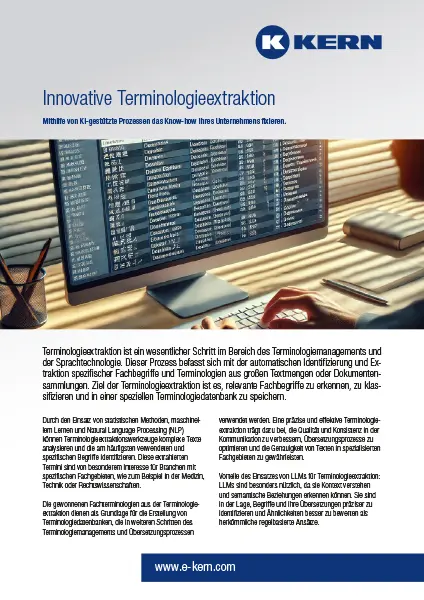
Innovative terminology extraction
All of the benefits, areas of application, and services in brief—clearly presented on an information sheet.
FAQs about our terminology management
You will find short answers to the most important questions about terminology management here.
What is terminology management at KERN?
Terminology management means systematically collecting, defining, and managing company-specific technical terms. This ensures that the same terminology is used consistently in all languages and documents, both internally and externally.
Why is professional terminology management important?
Solid terminology management prevents misunderstandings, promotes clarity and consistency in corporate communications, and improves the quality and efficiency of your translations and documentation.
What exactly does KERN's terminology management service offer?
KERN creates company-specific terminology databases, glossaries, and equivalence tables—tailored to your company's individual needs. In the process, existing terminology databases can be cleaned up and standardized or completely rebuilt.
How does the terminology creation process work at KERN?
First, KERN analyzes your existing documents and automatically extracts relevant technical terms. The terms are then validated together with you and maintained as a terminology database — for consistent use in all future projects.
For which companies or industries is terminology management particularly suitable?
This service is particularly valuable for companies with technical documentation, complex specialist content, or international business — e.g., in the fields of technology, medicine, law, or export — where precise and consistent language is crucial.
How does terminology management support translation quality and efficiency?
Translators can access previously validated terms via a central, well-maintained terminology database. This ensures consistency, reduces errors, and speeds up translation and approval processes — ideal for recurring or large projects.
Can existing internal company terminology be adopted and consolidated?
Yes ‒ KERN can consolidate existing terminology databases, glossaries, or department-specific lists, clean them up, and transfer them to a uniform, central database. This allows you to ensure consistency in the use of all technical terms throughout your company.