
The most common challenges in translating financial reports
A financial translation is much more than simply translating figures – it is a strategic communication tool. If financial reports are not translated accurately, the trust of investors, regulators and employees suffers.
Even minor discrepancies – a misinterpreted IFRS term, inconsistent terminology or a transposed digit – can alter the meaning of an entire report.
Many companies rely on freely available online translation tools to save time. However, machine-based systems lacking the necessary technical context cannot reliably identify defined, subject-specific phrasing – such as that used in IFRS or client-specific terminology – which can lead to discrepancies in content and associated risks. Furthermore, data protection and confidentiality are not guaranteed with many standard solutions.
The consequences range from misunderstandings in financial communication to reputational damage – a risk that could be avoided if expertise, technology and quality assurance in accordance with ISO 18587 were properly combined.
How to produce a professional financial translation – requirements & success factors
A professional financial translation requires not only linguistic precision, but also sound business and legal expertise, particularly when it comes to selecting and correctly applying the relevant accounting standards. Financial reports are complex documents produced by different departments that must present a consistent overall picture. Achieving this requires seamless collaboration between project managers, specialist translators, terminologists and post-editors.
KERN’s Finance Competence Centre pools this expertise and ensures that every translation is accurate, consistent and terminologically correct. In addition to the translators, editors, layout designers and DTP specialists ensure that the layout is correctly implemented after translation – so that the structure of tables, diagrams and footnotes is also fully preserved in the target language.
Key quality factors in a professional financial translation:
- Terminological consistency: Technical terms are used consistently in accordance with IFRS, HGB, ESRS and CSRD.
- Consistency & style: All sections – from the management report to the notes – have a consistent and professional tone.
- Confidentiality: Translations of sensitive data are carried out exclusively on secure, GDPR-compliant systems.
In addition, glossaries, translation memories and style guides are continuously updated to ensure that your financial communications meet the same high standards in all languages. These maintenance processes save time and money in the long run, as only new content needs to be translated in subsequent reports. Companies that publish reports on a regular basis thus benefit from consistent wording and a clear linguistic style sustained over several financial years.
Are you interested in our services?
Please get in touch with us using the contact form, by telephone or book an online meeting – we look forward to hearing from you!
How AI supports financial translation – tools, standards and quality assurance
Artificial intelligence is transforming translation processes – but it does not replace human responsibility. Modern systems such as MT4client™ from KERN enable the secure use of machine translation whilst complying with the highest data protection standards. The key lies in its controlled use: AI is used where it improves efficiency, whilst specialist translators ensure quality and style.
In a professional workflow, several technologies work together:
- Translation memories (TM): these store previous translations and ensure consistent terminology across all reports.
- Terminology databases (TB): these ensure that all official terms, abbreviations and spellings are automatically used correctly.
This combination helps to reduce time and costs without compromising on quality.
The subsequent post-editing phase in accordance with ISO 18587 ensures that machine-translated texts are flawless in terms of style, language and subject matter. In financial communications in particular, this means: no transposed digits, correct decimal separators, country-specific currency formats and consistent terminology.
Best practice: companies with international subsidiaries can use MT4client™ to create centralised termbases. This means that translators around the world have access to the same terminology and layout standards – regardless of time zones or departmental structures. The result is reports that have a consistent tone worldwide, comply with regulatory requirements and can still be published quickly.
Your checklist for reliable and professional translations of financial and sustainability reports:
Case study: AI-powered financial translation in practice
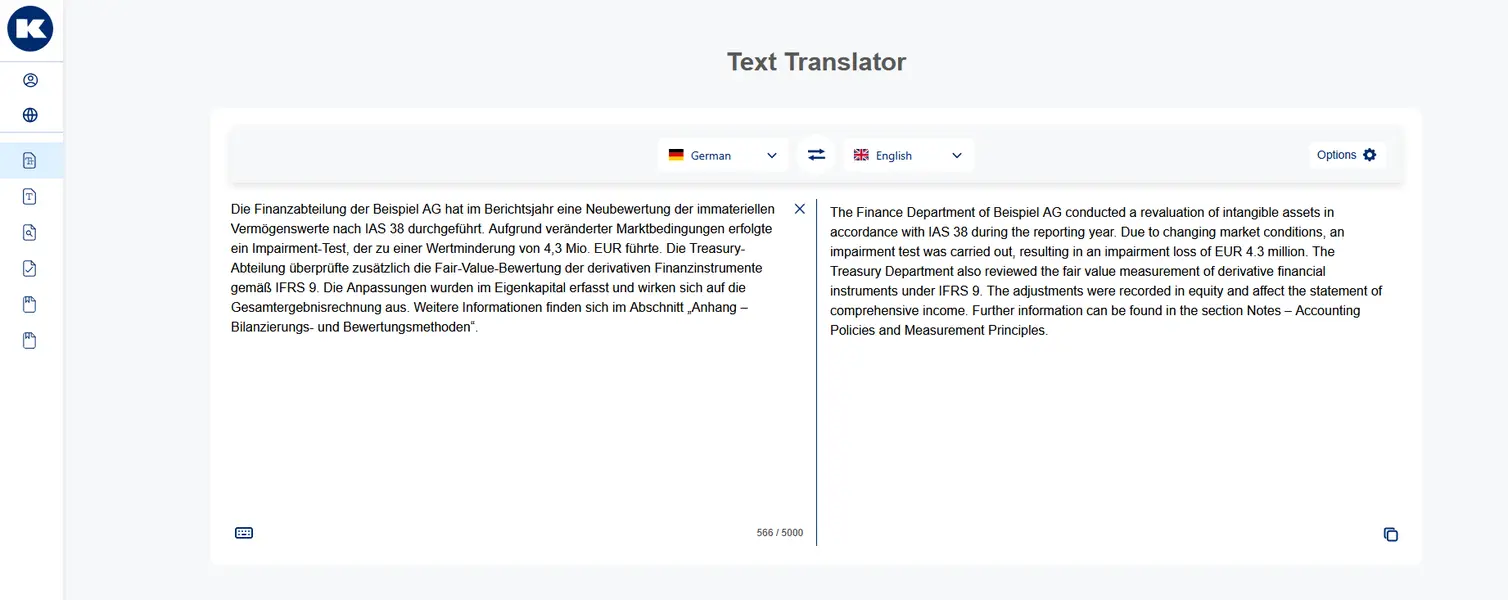
At the Finance Competence Centre, a sample text was used to demonstrate how translation quality and efficiency can be improved through the use of a translation memory (TM) and a termbase (TB). Without these systems, inconsistencies between chapters, differing terminology or redundant processing steps often occur.
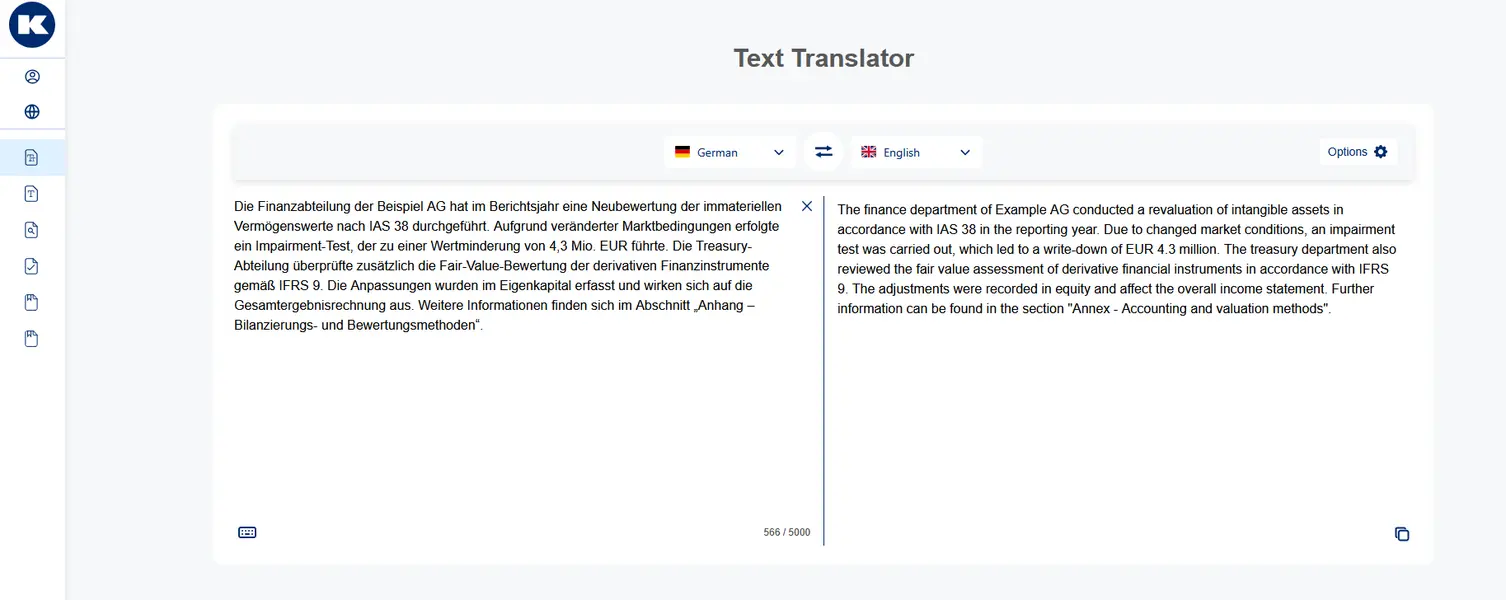
With TM and TB, on the other hand, recurring phrases are automatically recognised and incorporated, which significantly simplifies translation quality assurance. Specialist translators focus on subtle nuances in the content, whilst routine passages are processed using AI. The result: significantly shorter processing times, greater consistency in terminology and a fully audit-proof translation process.
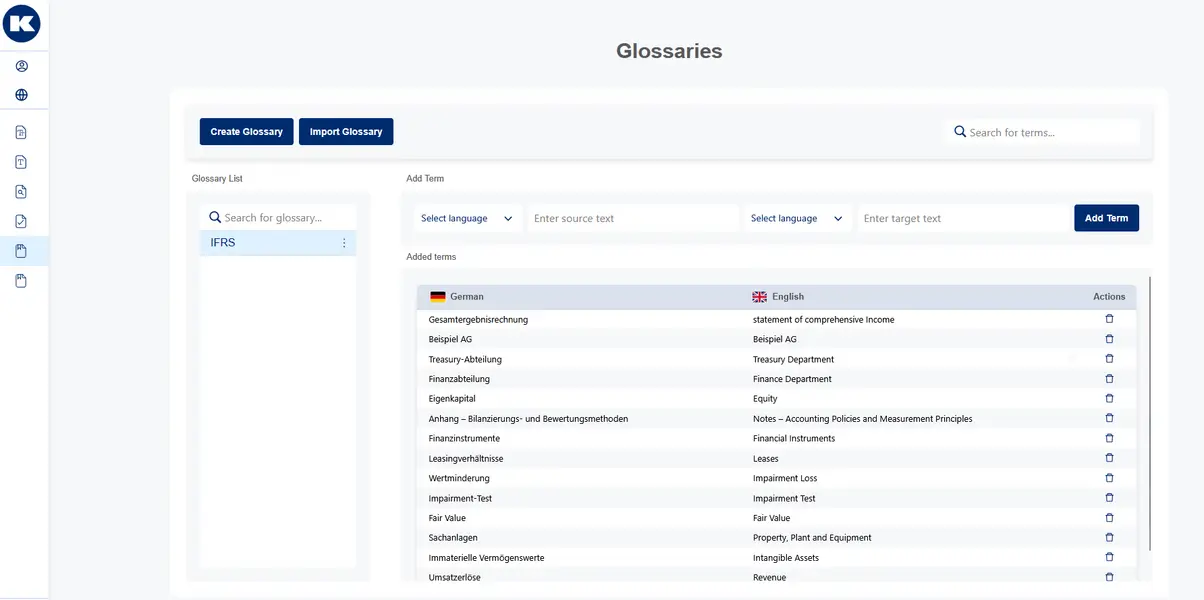
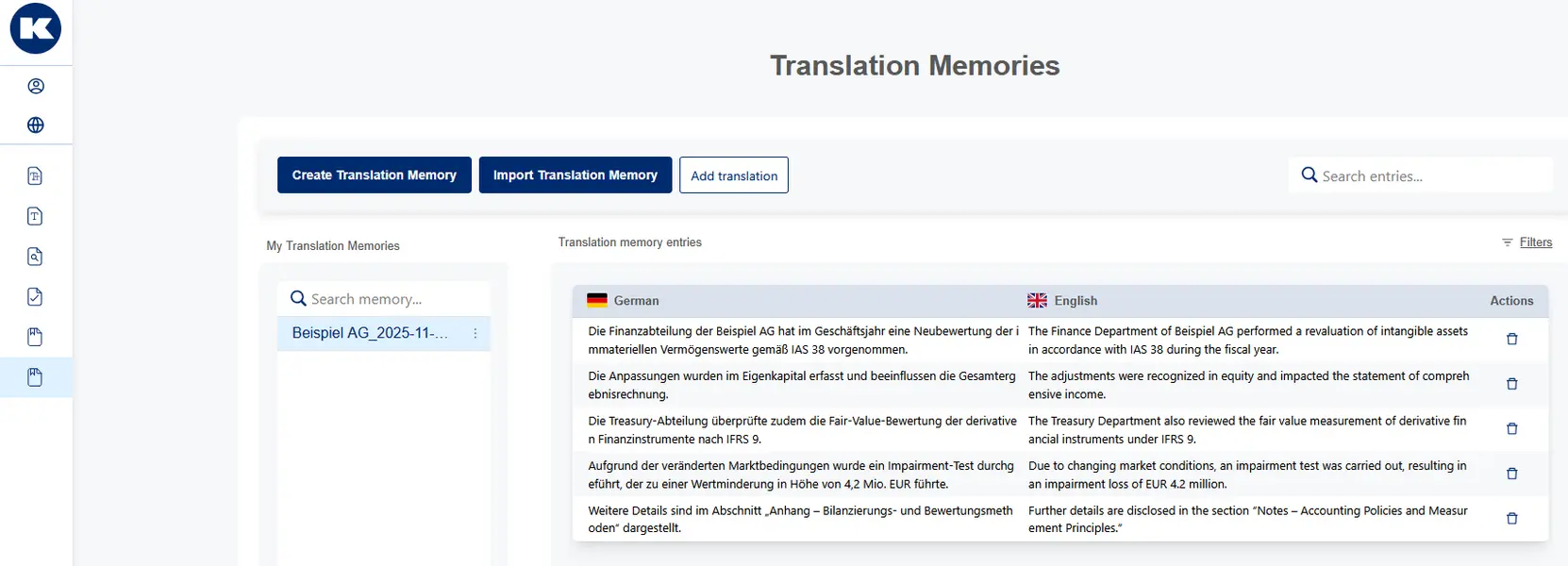
This approach demonstrates that AI and expert knowledge are not mutually exclusive, but rather complement each other perfectly – provided they are managed professionally and implemented in accordance with defined standards.
Kick-off meeting & project preparation – the crucial first step
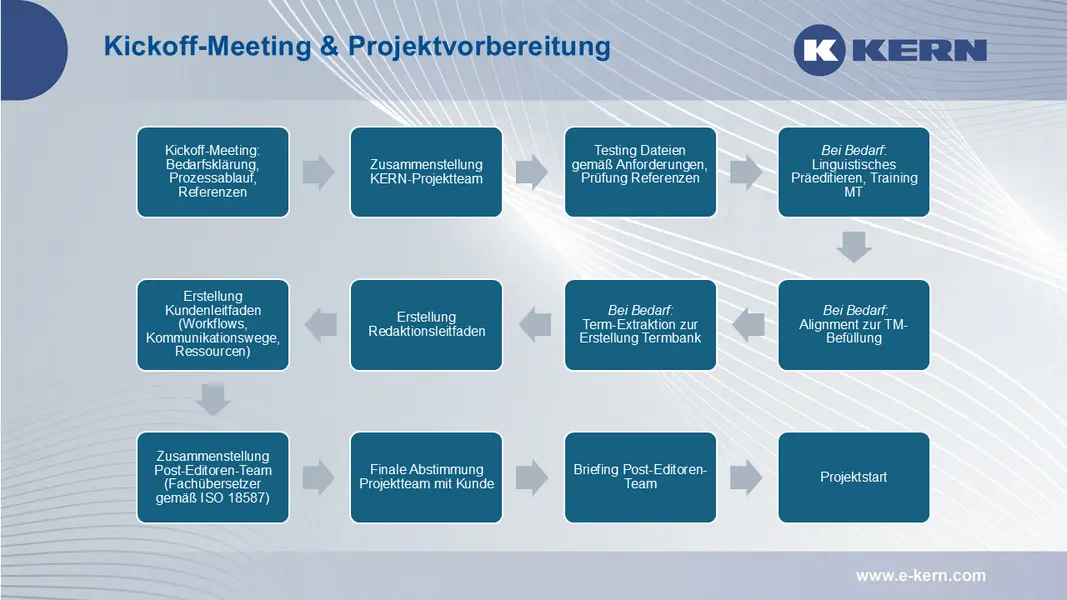
Before a financial or business report is translated, the process begins with a structured kick-off meeting. This step is crucial for clearly defining roles, expectations, terminology and technical requirements. Particularly when it comes to complex reports involving several departments, a professionally organised kick-off meeting ensures that everyone involved is working towards the same goals and that potential risks are identified at an early stage.
The following points will be discussed at the kick-off meeting – and form the basis for the smooth running of the entire translation project:
- Coordination & allocation of roles: Who is responsible internally, who will manage the project, and who will provide references and terminology?
- Process & timeline: Which chapters are already finalised, which will follow later, and how will partial deliveries and approvals be organised?
The diagram below from our Finance Competence Centre shows how KERN structures this process: from terminology coordination and file preparation through to technical testing and the final handover to the translation team. A carefully planned kick-off meeting not only saves time and money, but also ensures that the quality of the translation is guaranteed right from the start.
Are you interested in our services?
Please get in touch with us using the contact form, by telephone or book an online meeting – we look forward to hearing from you!
The MTPE process in accordance with ISO 18587 – Quality assurance for AI-assisted financial translations
Once the machine pre-translation is complete, a crucial step in the professional financial translation process begins: post-editing in accordance with ISO 18587. This internationally recognised standard sets out clear requirements for the post-editing of machine-generated texts – and ensures that an AI-generated result meets the same quality standards as a fully human translation.
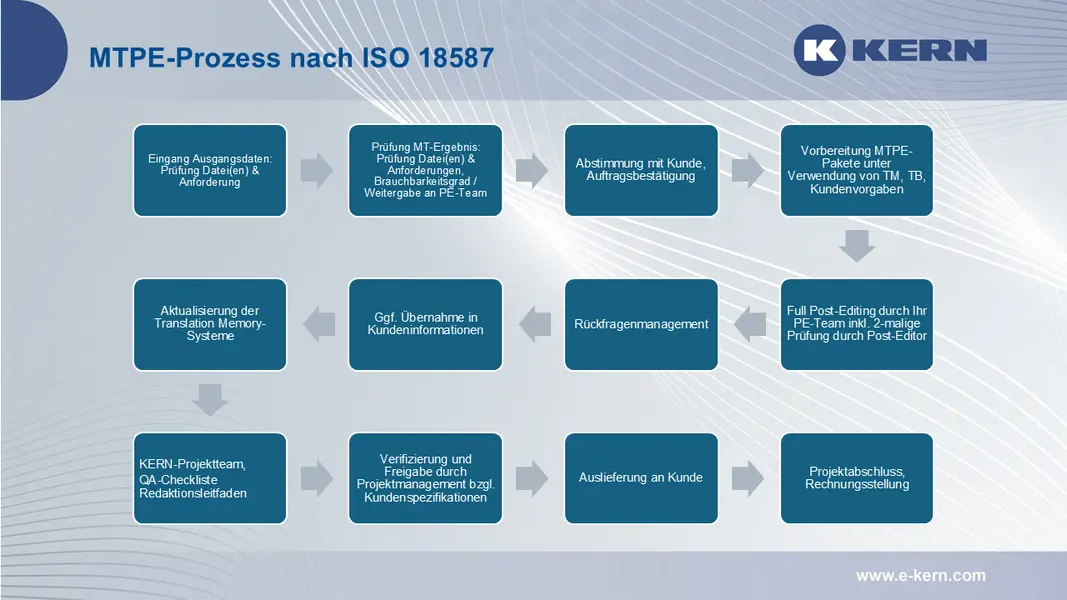
The MTPE process (Machine Translation Post-Editing) comprises several carefully coordinated steps that are essential, particularly in the financial sector. This is because it is not only the language and style that must be correct, but also the terminology, formatting, consistency of figures and regulatory requirements.
The MTPE process in accordance with ISO 18587 includes, in particular:
- Linguistic quality check: The post-editor checks the grammar, sentence structure, style and readability of the machine-translated text.
- Terminology and fact checking: All relevant terms – such as those from IFRS, HGB, ESRS or company-specific glossaries – are systematically checked and corrected.
- Consistency checking: Recurring phrases, table headings and technical terms are standardised to ensure consistency across all chapters.
- Formats & numbers: Number formats, decimal separators, currency symbols and table structure are checked to ensure compliance with country-specific requirements.
The post-editor uses the prepared translation memories, termbases and style guides to ensure the quality of the translation throughout the report. This process is particularly crucial when it comes to financial and sustainability reports, as even the slightest discrepancies can immediately undermine trust and the reliability of the information.
The slide in the figure below shows the complete MTPE process as it is used at KERN’s Finance Competence Centre – including quality checks, technical preparation and the final approval process.
The result is a translation that harnesses the benefits of AI without compromising on accuracy, style or regulatory compliance.
Conclusion – Quality remains a responsibility
Artificial intelligence unlocks enormous potential, but real quality can only be achieved through human insight and experience. A financial translation is not merely a linguistic product, but a strategic component of corporate communications. Particularly in the wake of new regulations – from IFRS updates to ESRS and CSRD – the demand for accuracy, transparency and style is increasing.
KERN is synonymous with professional financial translations that combine technological efficiency with proven quality. With processes certified to ISO 17100 and ISO 18587, experienced financial translators and a clear focus on confidentiality, the company ensures that your financial communications are understood worldwide – accurately, securely and reliably.
Forward-thinking companies are increasingly turning to hybrid workflows: AI handles repetitive tasks, whilst experienced translators ensure your brand’s voice remains consistent. This way, what really matters is preserved – your credibility and your commitment to excellence.
Your next step
Get our free checklist for successful financial translations now and find out how to prepare your financial communications for maximum impact. We’d be happy to discuss your specific challenges during a free 15-minute consultation and offer you some initial ideas and suggestions for the next steps.
FAQ on professional financial translations
What makes a professional financial translation stand out?
A professional financial translation combines linguistic precision with in-depth expertise in accounting, compliance and financial communication. Specialist translators take account of country-specific standards such as IFRS, HGB or ESRS and work with terminology databases and translation memories. This ensures that the tone remains consistent, the figures are accurate and the report complies with legal requirements – regardless of whether it is an annual report, a sustainability report or a business report.
When is a certified translation of financial reports required?
A certified translation is required when official authorities, courts or regulatory bodies request the documents – for example, in the case of international mergers, audits or tenders. It is produced exclusively by sworn translators and bears a stamp and a certification note. This officially certifies that the translation is factually accurate.
How does AI support the translation of business reports?
AI can significantly speed up translation processes when used responsibly. When combined with translation memories, terminology databases and post-editing in accordance with ISO 18587, this produces high-quality results. Systems such as MT4client™ from KERN ensure data protection, consistency and efficiency – all under the supervision of experienced financial translators.
What role does ISO 18587 play in translation quality assurance?
The ISO 18587 standard sets out the requirements for the post-editing of machine-translated texts. It ensures that professional human translators review, improve and approve AI-generated translations for publication. In the financial sector, it ensures consistency, stylistic uniformity and accuracy of content – even in complex annual reports.
How does KERN ensure data protection in financial translations?
All financial translations are processed in accordance with the GDPR. KERN only uses secure servers within the EU and encrypted data transmission channels. Confidential data is not processed on public cloud services or freely available online translation platforms. This ensures that company information, key figures and forecasts remain protected at all times.
Does KERN also provide financial translations for companies in Austria and Switzerland?
Yes. With more than 60 offices worldwide, KERN also offers specialist financial translations in Vienna, Zurich, Basel and other cities in the DACH region. As a result, clients benefit from a local feel for the language and global expertise – for annual reports, sustainability reports and all financial communications.
How much does a professional translation of an annual report or sustainability report cost?
The costs depend on the volume, the language combination, the complexity and the required quality standard. At KERN we carry out an individual analysis and provide a transparent quote in advance. We can provide a no-obligation quote or a sample translation on request.